已发布演示与证据 / Published demonstrations & evidence
保留已公开 v0.2.0 的素材路径、实验条件和来源。本页不新增实验分数。 / Original public v0.2.0 assets, scientific captions and source identities are retained. No new experimental scores are introduced.
返回当前项目目录 / Back to the current catalog · 逐文件许可与署名 / Per-file licenses & attribution

KineJing / public research

World-model research,
made inspectable.

Action-conditioned representations, planning and reproducible evaluation. Explore the recordings, executed diagnostics and published evidence behind our work.

Public snapshot v0.2.0 · c50c2c7a

01

Recorded & executedFour demonstrations with explicit scope

02

Measured evidenceSix separate experimental comparisons

03

Reproducible sourcesCode, protocols, licences and file identities

01 / Demonstrations

See what actually ran.

Recorded inputs, executed computations and environment replay. Each example keeps its original source and authors attached.

4 demonstrations

Recorded robot observation beside actual CPU Farneback flow and motion measurements Watch featured demo

Recorded input / CPU diagnostic

Observation + optical flow

16 seconds of recorded DROID footage, with actual Farneback computation and a fixed-scale motion timeline. The overlay measures image-space motion.

Footage: DROID / NVIDIA. Diagnostics: KineJing. No learned prediction or hardware control.

Recorded input / frame alignment

One episode. Three camera views.

Two exterior cameras and a wrist camera from DROID Panda episode 48330. Original frames 120–359 span source time 8.000–23.933 seconds; playback lasts 16 seconds.

KineJing decodes and checks 720 frames, then assembles the views. Matching indices do not establish camera calibration or robot control.

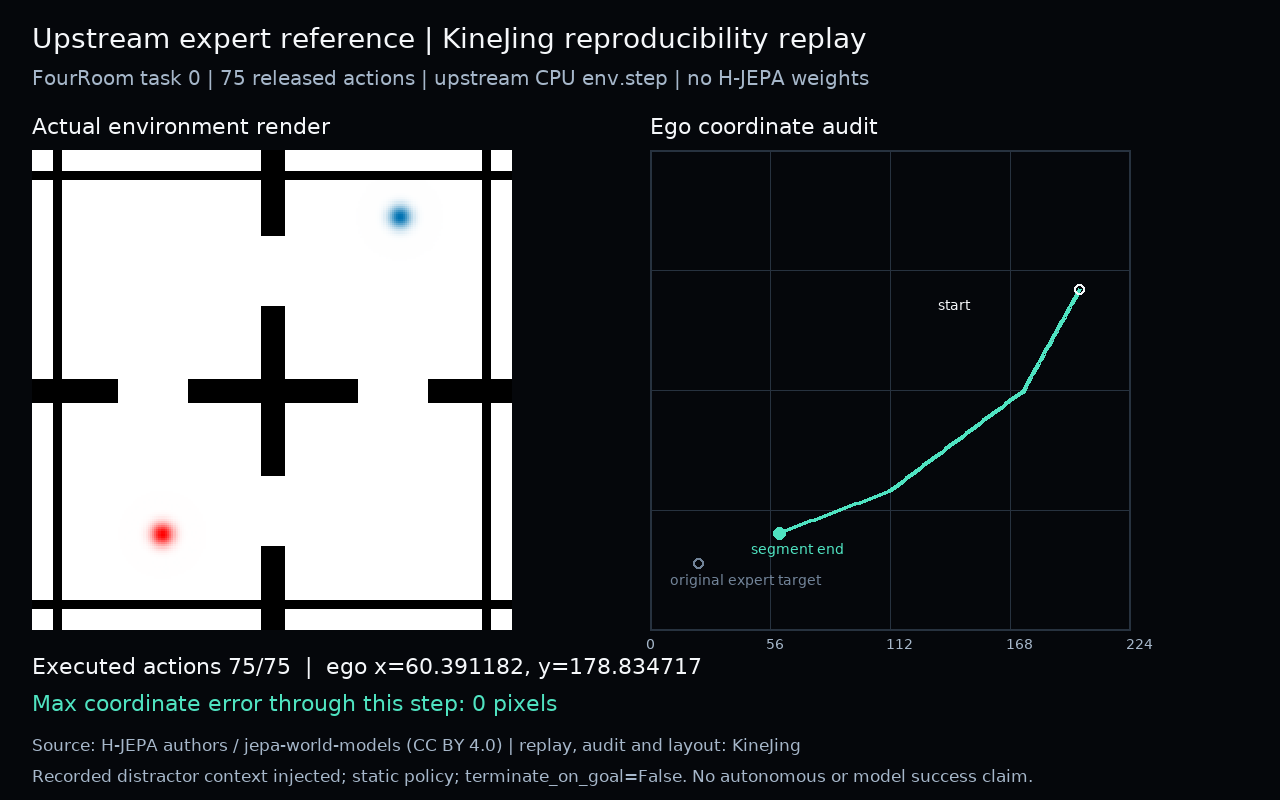
Executed environment / expert reference

FourRoom: 75 actions replayed

75 official expert actions executed through the upstream environment's env.step. All 76 measured ego positions match the released record, with maximum coordinate error 0.0 pixels.

Recorded distractors are injected as static context; goal termination is disabled. This is expert-reference replay, not H-JEPA inference or a navigation success test.

Actual H-JEPA GradientSolver CPU behavior on a deliberately overshooting quadratic objective Open full animation

Executed solver / declared toy objective

Retain an evaluated best candidate

The real H-JEPA GradientSolver evaluates (a − 1)² four times per arm. Default selection returns cost 64; optional retain-best selection returns an already evaluated cost 1.

A controlled CPU overshoot example with the same cost calls. It uses no model weights and measures neither planning success nor model quality.

Nine real DROID source frames with exact original timestamps

Look closer

Actual frames, retained timestamps.

Nine source frames from the same exterior-camera excerpt. Original source times and excerpt frame numbers stay visible.

Full stills & video gallery

02 / Published evidence

Six comparisons.
Six distinct protocols.

Original figures retain their axes, labels and sample counts. These studies test different questions; they form an evidence collection, not a combined model leaderboard.

6 comparisons

PushT pose versus coverage objectives: 33 of 50 versus 11 of 50 successes and mean peak coverage

01 / PushT · 50 paired scenarios

Planning objective changes the outcome

Pose objective: 33/50 successes. Coverage objective: 11/50. Both arms share the predictor, sensors and priors, horizon 20 and 192 rollouts per decision.

Up to 300 execution steps. The local protocol was frozen before held scenarios were accessed; this was not external preregistration. The result supports this objective comparison.

Protocol & paired outcomes
Three Physion frozen-feature readouts with AUROC and accuracy on 1189 samples

02 / Physion++ · 1,189 samples

Task supervision on frozen features

AUROC: 0.5672 logistic, 0.6751 contact ensemble, 0.6771 property-auxiliary ensemble. All use the same frozen V-JEPA-2 ViT-L features; added training-release supervision differs.

562 geometry groups. The test had been inspected previously: this is a re-evaluation, not a new blind confirmation. The small property-over-contact difference has no separate significance claim.

Conditions & all predictions
Selected true coverage on 64 inspected development contexts, including three local JEPA-head seeds and physical priors

03 / JEPA-WMs · 64 development contexts

A small gain with physical priors

Selected true coverage is approximately 47.09–47.12% for three local JEPA-head seeds and 47.32% with physical priors: about 0.20–0.23 percentage points.

Eight candidates per context, five-step endpoint. Contexts were previously inspected; added geometry, camera and controller priors do not isolate an architecture gain or unseen control.

Paired rows & scope
Normalized frozen-DINOv2 feature MSE for an action-conditioned predictor, persistence and shuffled actions

04 / Feature prediction · 10 episodes

Action conditioning in feature space

Normalized MSE: 0.8357 predictor, 0.9919 persistence, 0.8956 shuffled actions. The published predictor aggregate is 15.75% lower than persistence.

Frozen DINOv2 features; 80/10/10 episode split, one training seed. Public development examples were explored. Only aggregates are public; this is not a new model rerun or an RGB-quality metric.

Aggregate identities & conditions
One matched H-JEPA pilot: both arms succeed; baseline 186 versus retain-best 192 environment steps

05 / H-JEPA · one matched pilot

Both succeed. No success-rate gain.

Baseline: 186 environment steps. Optional retain-best candidate: 192. Both succeed 1/1; the candidate takes six more steps in this task.

Same released L3 checkpoint and 50/200/200 candidate budget; up to 90 optimizer iterations. The separate 300-episode comparison was in progress at this snapshot and is not plotted.

Pilot configuration & records
Controlled released-L3 rollout kernel: latency and peak allocated CUDA memory for backward, action-only gradients and cache

06 / H-JEPA · controlled L3 kernel

Measure the engineering change

Median latency: 134.925 / 103.953 / 105.850 ms for original backward / action-only gradients / action-only plus cache. Five warmups and 20 matched rounds per arm.

FP32, released seed42 L3, 200 candidates, horizon 6, RTX 5070 Ti Laptop. Encoding, optimizer and environment stepping are excluded. Memory has one peak measurement per arm; cache latency benefit is inconclusive.

Raw timings & kernel protocol

The first three comparisons include public per-sample CSVs. Feature prediction exposes aggregate values. The pilot and kernel preserve their recorded conditions. Read the complete evidence guide.

03 / Reader's guide

A map of the work.

Three authored schematics explain the research branches, optional engineering changes and evidence process. They are guides, not experimental measurements or completion records.

Research map connecting four work branches with six selected chart protocols and reproducible sources
Research & selected evidenceRead the English / Chinese diagram guide
H-JEPA opt-in engineering: retain-best finite feasible candidates, action-only gradients and guarded action embedding cache
H-JEPA engineeringIndependent optional switches, defaults preserved.
Source-to-publication evidence process: freeze inputs, execute, validate and publish with source identities
Evidence & publication processProcess schematic; completed checks live in their records.

04 / Maintained engineering

Build on the original work.
Make changes inspectable.

Our maintained H-JEPA extension provides optional planner and runtime changes, CPU regression tests and reproducible measurement records. H-JEPA's original model, training work and paper remain attributed to its authors.

Public project directory
01

Retain evaluated best candidates

Keep finite, feasible candidates per environment. Opt-in behavior, with unchanged default selection and no additional objective calls.

Actual upstream contribution ↗
02

Compute only action gradients

An optional gradient path avoids accumulating unused model-parameter gradients. Controlled kernel measurements define its tested scope.

Published benchmark protocol ↗
03

Guard repeated action embedding work

An independent optional cache uses evaluation-mode and tokenwise guards. Its measured cache latency benefit remains inconclusive.

Fixed extension source ↗

05 / Inspect & reproduce

Start with the source.

This page presents the existing public v0.2.0 collection. The linked source snapshot fixes media, protocols and file identities to one revision.

A clear publication boundary

This gallery retains its published v0.2.0 conditions and source identities. The current catalog provides the reviewed technical releases. Original sources, redistribution terms and attribution remain attached under the per-file licences; linked historical policies describe their own source snapshot.

Read the per-file licences